
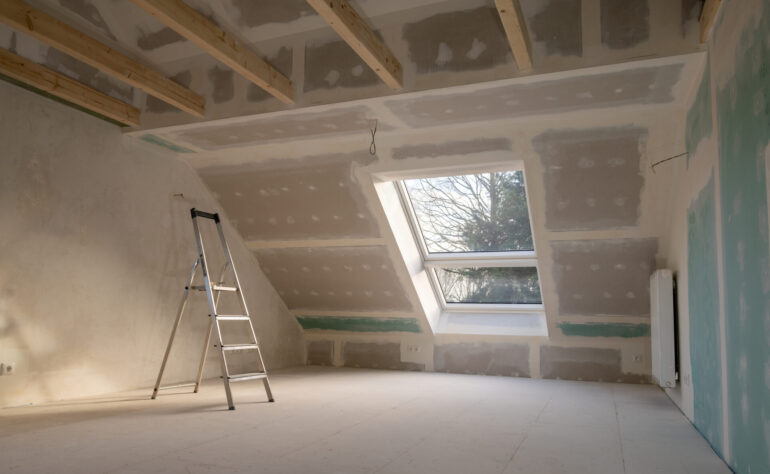

Landlords have been extensively upgrading their rental portfolios over the past five years, even as more than half say they regret undertaking the work, data from The Mortgage Works has found.
The findings highlighted both the scale of investment across the private rented sector (PRS) and the mixed returns landlords report receiving.
According to the latest analysis, 88% of landlords have renovated at least one rental property in the past five years.
Kitchen and bathroom refurbishments were the most common improvements, carried out in around one in five upgraded homes.
Green enhancements were also notable: 18% of renovated properties saw additions such as solar panels, improved insulation or EV charging points – measures partly driven by minimum energy efficiency standards (MEES).
Larger-scale projects were also prominent, with 17% of privately rented homes receiving multi-storey extensions and 15% undergoing basement conversions.
A significant proportion (68%) involved converting properties into houses in multiple occupation (HMOs).
Average spending totalled around £88,000 per landlord, or approximately £43,000 per property.
Despite these investments, the report revealed striking levels of regret.
51% of landlords said they regretted renovating, citing loss of rental income during void periods, unexpected costs, or disappointing outcomes such as lower-than-expected rent increases.
This stands in sharp contrast to owner-occupiers, only 4% of whom regretted renovating.
Landlords’ motivations ranged from attracting tenants and reducing void periods (27%) to boosting property value (25%), meeting regulatory standards (22%) and increasing rental income (23%).
More than 80% raised rents after completing works, with an average uplift of 17%, and nearly a third increasing rents by more than 20%.
Senior economist Andrew Harvey said: “Nearly nine in 10 (88%) landlords have undertaken renovations on at least one of their rental properties over the past five years, according to our latest research.
“We’ve used our data to look at the factors that affect the values of BTL properties, and the potential to add value.
“While we can’t identify the value associated with kitchen and bathroom renovations, we are able to explore the impact of more substantial projects, particularly those which increase the size of the property.
“Location remains key to house values, but other factors, such as the number of bedrooms and bathrooms, are also important to landlords. Improvements that increase the size of the property, such as an extension or loft conversion, can add value and boost rental income.
“Interestingly, our analysis suggests there’s a larger premium for an additional bathroom in the BTL market compared with owner occupier. For example, adding a second bathroom to a BTL property adds 8% to its value, around twice as much as for an owner-occupied property (4%).
“Adding space to create an additional double bedroom can add 13% to the value of an existing two-bedroom house. The table below shows the value added for the main BTL house types by increasing floor area to accommodate an extra bedroom.”
He added: “Landlords that add a loft conversion or extension, incorporating a large double bedroom and bathroom, can add as much as 24% to the value of a three-bedroom, one-bathroom house. This is similar to what we see in the owner occupier market.
“We’ve also explored how making improvements can impact potential rental income. Our analysis suggests that adding space to create an additional double bedroom can add 12% to typical rent, equivalent to around £125 per month (compared to an existing two-bedroom house).
“Meanwhile, a BTL property with a second bathroom attracts a 6% rental premium (around £60 per month). Landlords undertaking a larger scale project such as loft conversion could potentially see a rental uplift of 26% – around £285 per month on the typical rental property.”
Harvey continued: “Aside from extending, another way to add value is to improve energy efficiency. These is particularly relevant to landlords since the introduction of minimum energy efficiency standards (MEES).
“As we explored in our PRS report last year, a more energy efficient BTL property (rated A or B) attracts a significant premium of 10.9% compared to a similar property rated ‘D’ (the most commonly occurring rating).
“Ultimately of course, the decision to invest in a property is an individual one, which has to take into account the costs and hassle involved, as well as potential benefits.”