The Intermediary… Steve Palfreeman, head of sales – bridging finance at Allica Bank
Steve Palfreeman, head of sales – bridging finance at Allica Bank, explores the role of technology, certainty and broker relationships in delivering bridging finance.

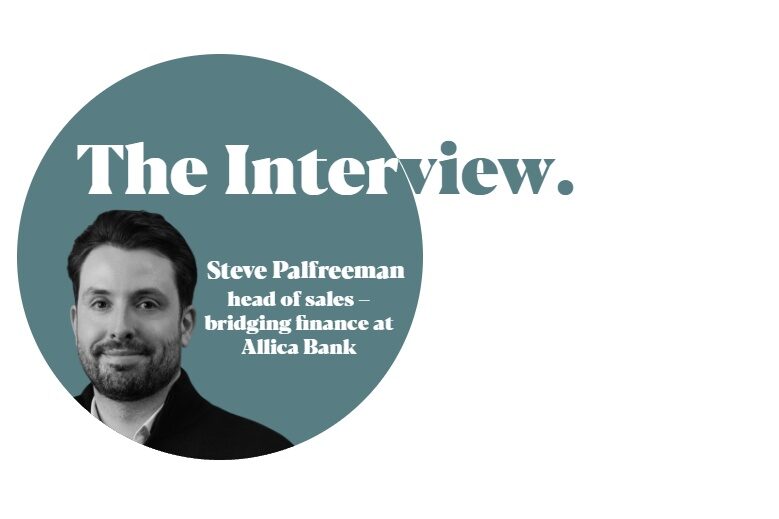
The Intermediary speaks with Steve Palfreeman, head of sales – bridging finance at Allica Bank, about the role of technology, certainty and broker relationships in delivering faster, more flexible bridging finance.
Allica has extended its use of automated valuation models (AVMs) to eligible residential bridging loans of up to £2m. What prompted the change, and what difference will it make for brokers and borrowers?
Our AVM replaces time-consuming physical inspections with intelligent data analysis. Your clients get valuations on residential purchases and refinances, without the extra costs, delays and uncertainty that can come with traditional valuations.
We recently increased the maximum loan-to-value (LTV) from 70% to 75% and more than doubling the maximum loan size for an AVM from £750,000 to £2m.
There’s now a range of technology available with data that’s improving constantly, particularly in the residential market.
We wanted to find a way of using AVMs for a wider breadth of residential property. Our AVM tool was restricted in terms of LTVs and property values, which had come up in broker feedback. It’s always useful for product enhancements as it helps us to decide what to prioritise.
The data was there and we were lending at those leverage points with full valuations, so we developed the technology to do it.
We compared RICS valuation reports with AVM reports to see how closely they matched. The strong results gave us the confidence to expand our use of the tool and broaden our appetite to focus on a wider range of lending opportunities.
Giving people an instant valuation without having to pay for it has made us market-leading for borrowers and brokers. It’s a strong product. There’s a lot of pressure on property sales and prices in general, so valuation certainty is becoming one of the most important things when assessing a deal. This is especially important in bridging.
A broker can pick up the phone and get an AVM instantly at no cost to the borrower, then get an application form across and instruct legal on the same day. It speeds up that journey and gives certainty from the start.
Where do you draw the line between cases that can benefit from an AVM and those where a physical valuation is still necessary?
We got to a point with our residential AVM where we were able to replicate a residential valuation to incredibly high accuracy. This made us comfortable relying on the technology for deals up to £2m.
Commercial and semi-commercial property can have more complexity. For these and residential deals over £2m, we still need to perform physical valuations. We’re always looking at how we can expand our use of AVMs as we appreciate how important speed is, regardless of the type of property.
Speed has traditionally been one of bridging’s main selling points. Is speed alone still enough to compete in the market today?
Speed is critical for everybody. But certainty and relationships are becoming increasingly important, too.
Bridging is a relationship business – people are essentially buying trust at the end of the day. Brokers want to pick up the phone and find out where they are on an application to talk someone through a more complex case.
Brokers want certainty from day one. It’s a real value-add when they can go back to their clients and say they’ve spoken to a lender and already have a valuation report.
Speed is still the top priority for us, it’s central to what we do. But we do also offer that certainty and a relationship-led approach.
You’ve talked about giving brokers confidence in a lending decision from the outset. What does that look like in practice, particularly on more complex cases?
Our bridge-to-term proposition gives brokers and borrowers certainty from the outset with an exit at the end. There aren’t many lenders that are doing it. We give brokers someone they can talk to, and access to the underwriter to properly explain the case and build trust.
We have a relatively small bridging team, but we use a combination of technology and human expertise to be nimble and make quick decisions on what we can lend, giving that certainty.
We recently worked with Arose Finance to deliver a £6.75m development exit facility that didn’t have a typical structure. It had nine different properties across residential, semi-commercial and commercial, with a wide range of asset classes, three different borrowing structures, and at 75% LTV.
We structured a loan to cross-collateralise across the whole portfolio, allowing the borrower to pay off existing finance, release equity, and repay the loan from their sales proceeds. It was a unique underwriting situation.
Allica’s bridge-to-term proposition now accounts for around 45% of bridging enquiries. What is driving that demand, and are brokers increasingly looking for an exit strategy to be established at the beginning of a bridge?
We launched our bridge-to-term proposition last year, offering short-term finance to bridge gaps in funding or operations with an automatic transition to a term mortgage once criteria are met.
Our case studies show that people are realising what value the product can bring, with fast decision making and underwriting, cost savings for the client, and the exit at the end. Demand is only getting better, and as with any new product or process, we’re improving as we go.
Brokers are drawn to that certainty of establishing an exit strategy at the beginning of a bridge. But there’s a lack of availability in the market for something similar, especially with our commercial refurbishment products.
I think it’s a fairly unique offering, and it’s not too often in bridging that you can come up with something unique. The most standard use case we’re seeing for bridge-to-term is a quick acquisition of a new office or commercial building that hasn’t got any trading history. They’re looking to buy an existing commercial space and then allow that asset to stabilise before moving on to term.
Refurbishments are a common example, especially of semi-commercial buildings with a business on the ground floor and residential apartments above. Bridge-to-term is a good solution until they get full occupancy and flip onto term.
What did your latest broker survey tell you about where bridging lenders are currently getting things right – and where brokers still want to see improvement?
Our broker survey shows that they really appreciate how technology is helping to speed things along. They also value the continued support of a business development manager (BDM), especially with complex cases. I think brokers are looking for a personal, relationship-led approach. They want lenders who find solutions. Our decision-makers are happy to jump on calls with brokers to make things happen with solicitors and try to move things along and get past roadblocks.
But there are still areas that brokers want to see improvement, and usually that’s about how we can make processes quicker and clearer to help them and their clients. For example, we have feedback in our broker survey about how we could better incorporate digital document signing into our process, so this is what we’re looking at how we can implement Docusign across the bank.
In your view, what does ‘good bridging’ look like to you in today’s market, and how different is that from when you first entered the sector?
I’ve been in bridging for over a decade, and it’s professionalised a lot. When I first started, bridging was a last resort for finance, now brokers and borrowers are realising it brings real value.
The Bridging & Development Lenders Association (BDLA) shared that the total loan book of their members stands at £11.5bn. It’s grown incredibly. More and more borrowers are seeing bridging as a vital tool and as an opportunity to get an uplift, compete against cash buyers and secure something quickly.
AI is the most obvious improvement. The changes that have been made in the last 12 months compared to the last 5 years have been unbelievable. How it facilitates reviewing reports, underwriting, the availability of credit memos and understanding deals is amazing.
It’s been a real time saver and added value to the bank, allowing us to focus on complex cases and building relationships with brokers. It will be really interesting to see what it looks like in five years’ time – I have no idea where it could go.
What’s next for Allica’s bridging proposition, and are there any further developments planned over the coming year?
2026 has seen Allica dramatically expand our bridging proposition, and we’re still just as ambitious to evolve and grow as we move into 2027.
Firstly, we will continue to innovate the types of bridging we can do, building on the successful launch of our bridge-to-term offering. For example, we’re already talking about idea that could help brokers and their clients capitalise on possible development opportunities that come from the upcoming Budget.
Our team will continue to invest in our technology to make working with Allica easier and faster than ever before.
Related

FRP secures £3m bridging loan for 144-home Tonbridge development

Paragon Bank joins the BDLA as associate member

FRP arranges £1.43m bridging loan for Swansea residential conversion

TAB converts commercial bridge into long-term semi-commercial mortgage

Phoenix Money joins the BDLA

Somo joins Swoop lender panel to expand broker access to bridging and second charge products

Bridging lending rises 5% in Q3 – MT Finance

Maslow Capital surpasses £838m in bridging finance completions in 2026

Modernising lender matching will transform SME financing

LendInvest promotes Dan Lohn as head of development finance

Nivo launches AI assistant for specialist lenders with free two-week trial